Field Notebooks
With a focus on the Ho community, extensive fieldwork was done in the states of Odisha and Jharkhand, India, in a region that the Ho people identify as Ho country. The main fieldwork was conducted in 2005-06 and 2009-10 and complemented by research on shorter return visits every year or two throughout the period between 2006 and 2019.
The hand-written data won in fieldwork over the years have filled a total of 17 notebooks – all accessible through this platform. All data were generated through participatory research and direct participant observation, complemented by structured and non-structured interviews. In addition, a large amount of pictures, transcripts of interviews, maps, a census survey, video-recordings and a lot more material were also produced. Not all has been published. All this material is unique and far too authentic and precious to remain neglected for good. Please do not hesitate to get in touch if you find anything of interest that you would like to use for academic and non-commercial purposes.
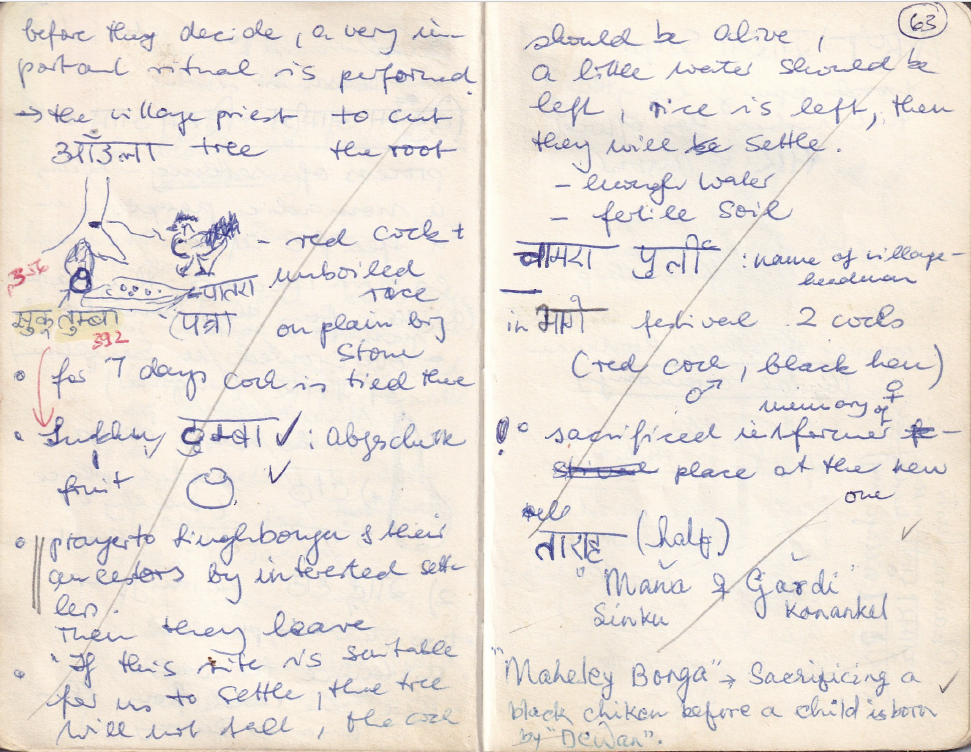
Notebook 1 - 7
This collection of seven notebooks and a summary document (“The Ho of Manbir”) records 2005–2006 fieldwork in Manbir, a Ho-majority village in Odisha, India. It documents everyday life, myths, rituals, kinship, festivals, pedigrees, interviews, and drawings, along with a “dictionary of Ho culture.” Organised thematically, it provides a foundational ethnographic record that informed later research on Ho society and culture.
Covers the period from 1.1.2006 to 13.02.2006
Covers the period from 13.02.2006 to 14.03.2006 plus excerpts on literature
found in the TRTC centre/Chaibasa.
Contains my drawings
Contains notes on rituals and a day-by-day diary from 3.1.2006 to 10.4.2006.
Covers the period from 13.03.2006 to 24.04.2006 and also my husband’s notes from his perspective.
Tapescripts of the tape recordings, the pedigrees a.o
A “dictionary of Ho culture” containing in alphabetical order key words that I have come across during my stay in Manbir/ Orissa. All of them I have checked as carefully as I could with the HO – English Dictionary (Deeney: 2005)
This script is an initial effort to organize my 2005–2006 field notes from village Manbir, documenting Ho life, rituals, myths, and interviews, forming the thematic groundwork for my eventual research focus.
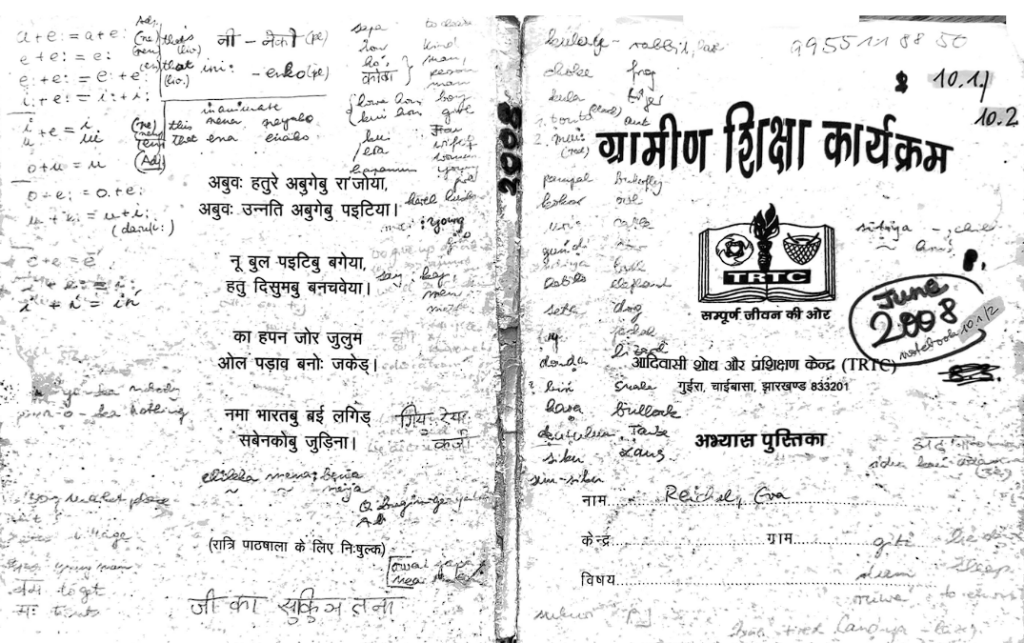
Notebook 8 - 12
This collection of five notebooks contains materials from a language course offered in Lupungutu/Jharkhand in June 2008. This course was addressed to Jesuit priests and candidates coming from various states in India, speaking different languages and learning Ho. I was invited to participate – the only woman in a group of 30 young and highly motivated males.
Notebook 8 contains my handnotes from Fr. Deeney’s book: Introduction to the Ho language and Ho Grammar and Vocabulary.
Notebook 9 contains excerpts from literature on the Ho which I found in the library of the TRTC in LPG and newspaper cuttings which I collected during the language course in June 2008.
Notebook 10 contains Ho language material from June 2008: grammar exercises, translations, idioms.
Notebook 11 includes data collected during my stay in Santal Sai, Mayurbhanj, Odisha, during the years 2008/2009.
Collaboration of Ho and Mahakud: Preparing Mage Porob in the respective sacred groves.
Notebook 12 covers Ho vocabulary and terms which I collected during fieldwork from 2009 – 2016.
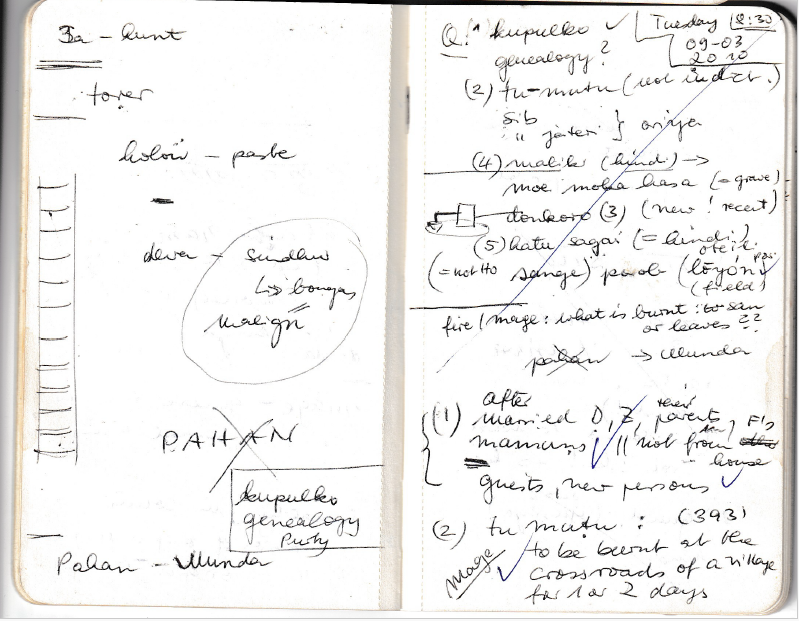
Notebook 13 - 14
These two notebooks record fieldwork from October 2009 to April 2010, while I was living in Santal Sai and Boja Sai, two hamlets of Tarana near Jamda, Mayurbhanj, Odisha. The first village was predominantly Santal, while the second exclusively Ho. They document daily life, household routines, festivals, funerary and life-cycle rituals, kinship relations, pedigrees, and language learning. They also capture the practical realities of fieldwork, including collaboration with friends, ritual friends, headmen (munda) and ritual guides (diuri), translation sessions, and the emotional and physical challenges of living in the community. A detailed index (click here) and a colour-coded chronology (click here) of key events complement these notebooks.
Notebook 13 main fieldwork continued in Santal Sai and Boja Sai in 2009-10: observing and participating actively in festivals and rituals at the household and village level, intensifying the saki relation, joining headmen and ritual guides in their daily duties
Notebook 14 uninterrupted continuation of notebook 13; chronicles fieldwork at Boja Sai, a pure Ho hamlet, in 2009-10, detailing household life, rituals, ancestors and spirit world, translation work, festivals, social web of miyad mandi chaturenko and pedigrees, while also reflecting fieldwork challenges.
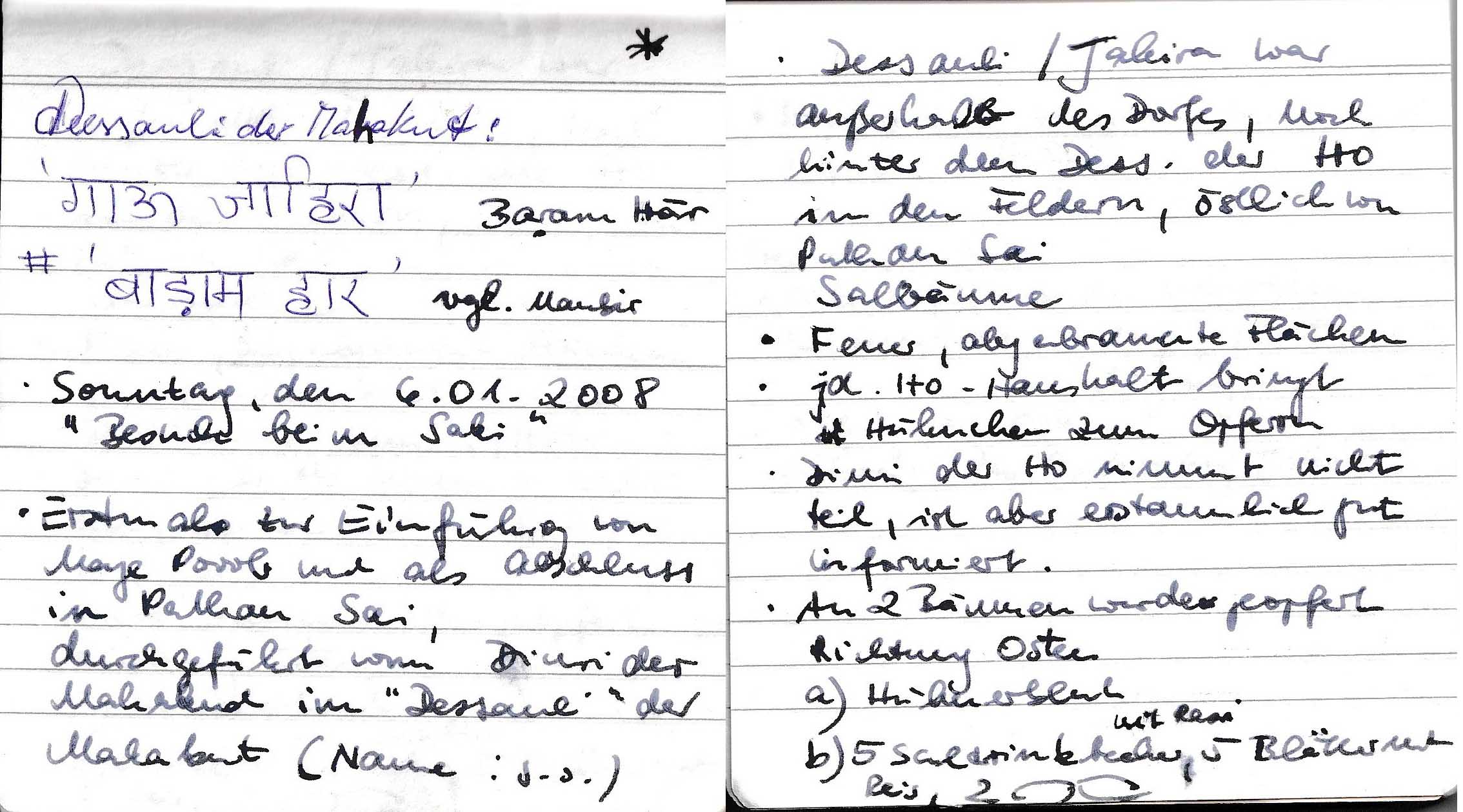
Notebook 15
Notebook 15 includes data collected during my stay in Santal Sai, Mayurbhanj, Odisha, in 2012. Perspectives of the Ho’s clients: convivium of Gao, Pano, andthe Muslim community and the Ho/ Santal; crossing tribal boundaries.
Notebook 16
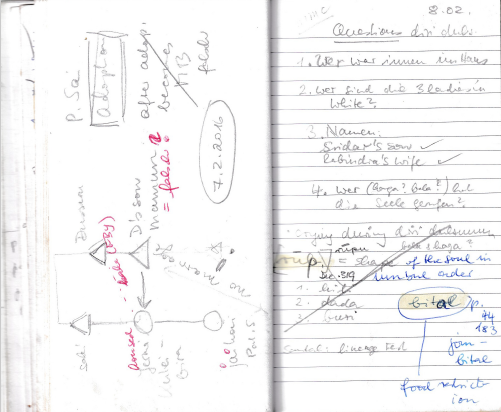
Notebook 16 includes data collected during my stay in Santal Sai and Boja Sai in Mayurbhanj, Odisha, during the years 2015-16.
Ethnography of friendship and the gender of ritual friendship; aspects of adoption
Notebook 17
notebook 17: sketching out the organisation of the Translation Project discussed with my collaborators in Chaibasa in 2019.