Historical Material
This section gathers critical works by scholars which have deeply informed my research, and which are difficult to access – either because their hard copies are rarely available or because they lack a digital version.
Here they are preserved with care and gratitude, both as a scholarly resource and as a gesture of recognition.
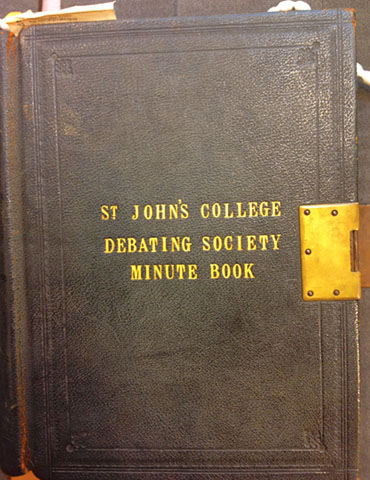
Jaipal Singh Minutes at St John’s College Debating Society
While studying at Oxford, Jaipal Singh joined his college’s Debating society first a as member, then as Secretary, and finally rose to the position of President. The minutes he took may be relevant to historians and political scientists as they reflect the making of a politician. Of interest are the motions he proposed, his interventions, and his sense of humour (see for instance minutes of meeting no. 554 in the year 1925, when he himself wrote: “Mr. Jaipal Singh, the Secretary, was greeted with applause when he stood up, but with much greater applause when he sat down”). Interestingly, the motion of his first meeting subtly challenged his presence at Oxford as a hockey champion – which he successfully rebutted in a witty manner!
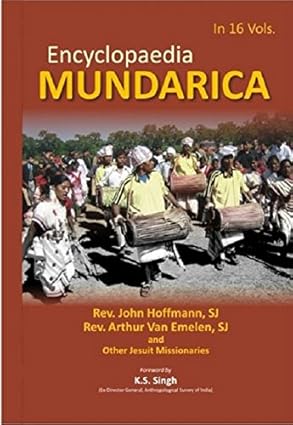
Encyclopaedia Mundarica
Encyclopaedia Mundarica, 15 vol., Patna, 1930-37. Reprinted Patna 1975.
Encyclopaedia Mundarica is a multi-volume scholarly work documenting the language and culture of the Munda people of the Chota Nagpur region. The project was initiated by the Jesuit priest John-Baptist Hoffmann and later completed after his death by Arthur van Emelen. During his lifetime, Hoffmann prepared 16 parts (sometimes described as 16 volumes, though in reality they formed five main volumes). After his death, the work was completed and published between 1930 and 1950, ultimately comprising 13 volumes of texts, which are listed below:
- Covers words beginning with A.
- Introduces basic vocabulary, early mythological concepts, and foundational social terms.
- Covers words beginning with B.
- Introduces basic vocabulary, early mythological concepts, and foundational social terms.
- Words under B.
- Includes terms related to agriculture, village life, and early descriptions of governance and clan organisation.
- Words under C.
- Focuses on ritual vocabulary, ceremonies, and aspects of traditional customs.
- Words under D.
- Contains information on marriage practices, funerary rites, and traditional healing.
- Words from E to G.
- Discusses farming cycles, forest life, festivals, and environmental knowledge.
- Words under H.
- Explains religious beliefs, especially spirits (Bonga), sacred places, and worship practices.
- Words under I and J.
- Includes songs, musical traditions, folklore, and myth narratives.
- Words under K.
- Details kinship systems, clan structures, inheritance customs, and land ownership.
- Words under L and M.
- Covers traditional laws, justice systems, dispute resolution methods, social organisation, leadership roles, and community life.
- Words under N and O.
- Describes nature worship, agricultural rituals, and the symbolic meanings of plants and animals in Munda belief.
- Words under P.
- Focuses on priesthood roles, religious festivals, ritual practices, and ceremonial specialists in Munda society.
- Words under R.
- Includes oral history, traditional narratives, mythological themes, and relations with neighbouring communities.
- Words under S.
- Discusses social rules, taboos, sacred laws, moral values, and traditional ethical practices in Munda society.
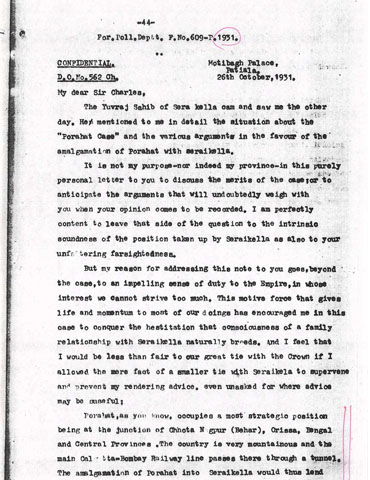
Political Dept. correspondence, South-West Frontier Agency
In the documents below, organized by date, you will find transcripts of the original correspondence between the Political Agents of the South-West Frontier Agency (as Chota Nagpur was also known in British India) and the Government of Bengal in relation to the so-called Kols’ Insurrection of 1830-33; various disputes and claims by the Rajahs of Singhbhum (including Rajah Arjun Singh), Porahat, Seraikela and Kharsawan, and Kolhan leaders, from years 1830 to 1931. The transcripts were obtained from the India Record Room in London and the New Delhi archives.
Correspondence between Capt. Wilkinson, Pol. Agent of the South-West Frontier, and G. Swinton, Chief Secretary to Government of Bengal, regarding the Kols’ Insurrection of 1830-33.
Correspondence about relations with Rajah of Singhbum/Porahat, Seraikela and Kharsawan, and Kolhan leaders. <read more>
Correspondence related to chief of Seraikella’s claims to the title of Rajah – which includes memorandum by Capt. Wilkinson.
Correspondence between H. Ricketts (1854) and G.G. Marrie, Under Secretary to the Government of Bengal regarding the petition by the Rajah Arjun Singh of Singhbhum in response to Seraikella’s claims. <read more>
Correspondence of M.G. Hallet Chief Secretary to the Government of Bengal and Orissa regarding the Maharaja of Seraikella’s claims over the Porahat estate. The file includes a “Note for discussion about Porahat case” with references to the rebellion by Rajah Arjun Singh during the Sepoy Mutiny of 1858; genealogy table of Porahat.
Correspondence between the Commissioner of Chota Nagpur and the Under Secretary of Government of Bengal 1854-1856 regarding succession of the Porahat estate and Seraikella claims to the same. The files include correspondence about the Kol’s insurrection of 1830s and witnesses’ statements. <read more>
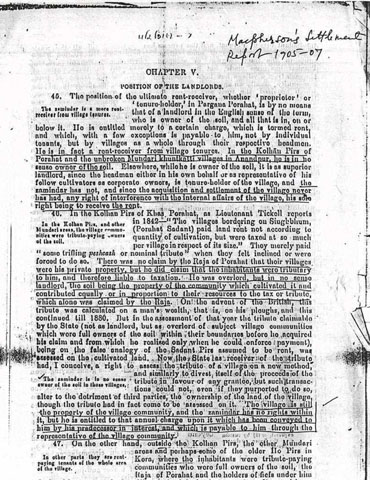
British Land Settlement Reports
British field officers in charge of land survey and settlement operations in Porahat and Kolhan between 1905-07, 1913-18, and 1928-32 demonstrate the British understanding of the Hos and Mundas’ notions of land and forest rights, as well as the ritual connection between land and people.
1908 Final Report on the Operations of a Record of Rights in Pargana Porahat District, Singhbhum (1905-07). By Macpherson T. S.
- Chapter V. Position of the landlords. Bengal Secretariat, Calcutta.
- Chapter XI. Mundari Khuntkatti. Bengal Secretariat, Calcutta.
Final Report on the Resettlement of the Kolhan Government Estate in the District of Singhbhum, 1913 – 1918, Patna. By A.D.Tuckey
- The report provides a detailed account of the geography, population, village administration, and customary institutions of the Kolhan area, with particular attention to Ho tribal society.
Final Reporton the Revisional Survey and Settlement Operations of Porahat Estate, District of Singhbhum, (1928-32) By Taylor, F.E.A. – India Office Records; IOR V/27/314/123 (India Land Settlement Reports)
- Chapter III: Mankis and Village Headmen.
- Chapter IV: Mundari Khuntkattidars – Origins.
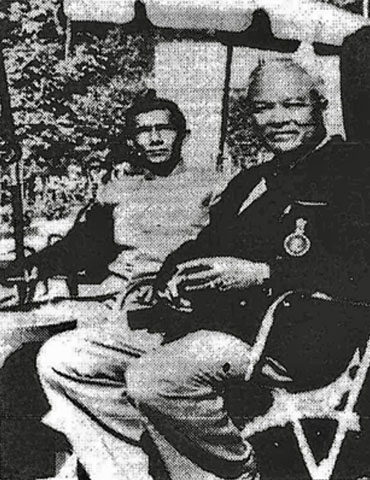
The autobiography of Jaipal Singh Munda, Marang Gomke.
Jaipal Singh’s son Amar Singh handed over the manuscript to my late BA supervisor Prof. Enrico Fasana in Bombay in the eighties. I shared this document with local tribal research institutes in Jharkhand during my fieldwork. In 2004, the manuscript was published in Lo Bir Sendra. An Autobiography. Marang Gomke Jaipal Singh. Edited by Rashmi Katyayan: Prabhat Khabar Publications. In 2025, Navayana got in touch to trace the origins of the manuscript and to publish it in its fuller form, adding explanatory notes and pictures. This very informative and comprehensive version of the autobiography is available at the link below.
Extract from the original Manuscript
“Undergraduate friendships are lifelong. It would be insanity to categorise or compartmentalise friends. My friendships were universal, if I may put it this way. Verrier Elwin born in Sierra Leone, son of a bishop, was the most brilliant student at Oriel. He got three firsts. He naturally became a Fellow of his college. His mother lived in Woodstock Road and she invited me to tea once a fortnight. Verrier Elwin turned religious. He became Vice-Principal of Wycliffe College. I did not appreciate this. Narrow-minded leftism is equal to narrow-minded rightism.”