Adivasi languages are spoken by millions of people across central, eastern, and northeastern India, especially in forested, hilly, and plateau regions such as the Chota Nagpur Plateau. Belonging to language families like Austroasiatic, Dravidian, and Tibeto-Burman, they represent some of the oldest and most vibrant living linguistic traditions of the subcontinent.
These languages are closely connected to land, memory, and everyday life. While Adivasi communities are often described as separate groups—Santals, Gonds, Mundas, Hos, Bhils, and many others—their cultures and languages exist along shared continuums, with flexible boundaries and deep connections. Learning an Adivasi language opens a window into Indigenous ways of knowing, relating, and belonging.
This section offers learning materials created to support that journey. Whether you are a student, researcher, community member, or simply curious, these resources invite you to listen, learn, and engage with Adivasi languages as living, evolving forms of expression—meant to be spoken, heard, and passed on.
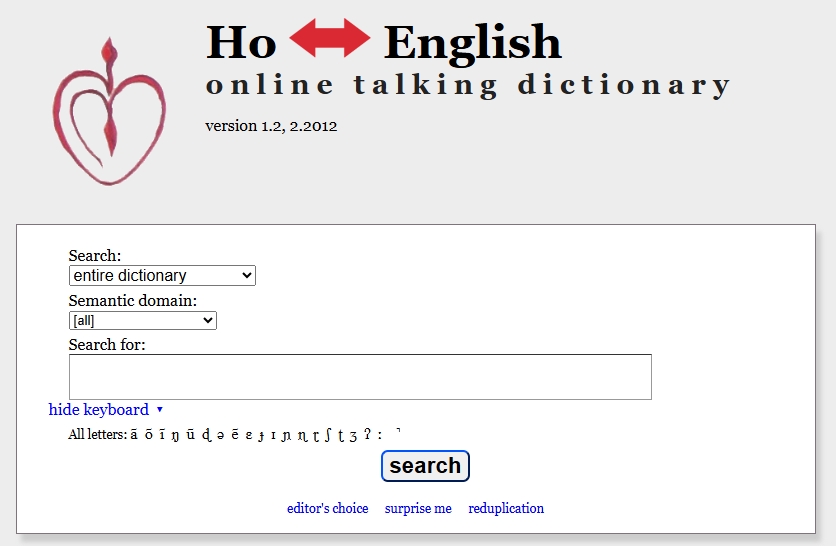
Swarthmore: Ho Talking Dictionaries
Launched in 2011, the Ho Talking Dictionary is an online linguistic resource dedicated to documenting and preserving the Ho language. It is developed by a team of linguists working with Ho speakers. The website features a talking Ho–English dictionary, allowing users to look up words and hear them spoken by native speakers. It is designed for everyday use by community members, students, teachers, and anyone interested in the Ho language.
The dictionary is part of the Talking Dictionary™ initiative, created by K. David Harrison, which helps languages be recorded and shared using sound and text together. The project has received technical and financial support from the National Geographic Society, the Living Tongues Institute for Endangered Languages, Swarthmore College, the National Science Foundation, and private donors. The views expressed on the site are those of the project team and do not necessarily reflect those of the funding organizations
Fr. Deeney's works on the Ho language
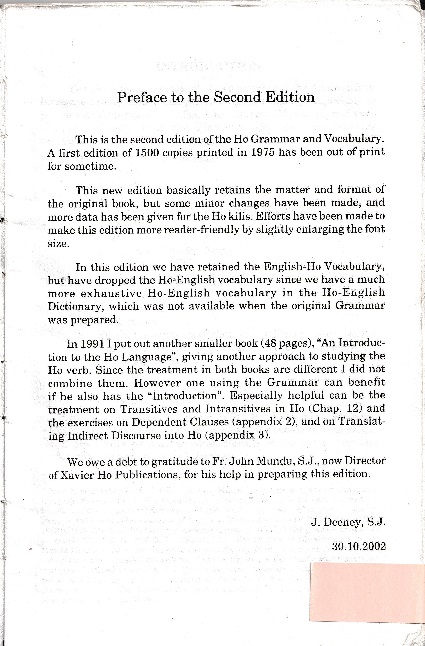
Fr Deeney made a significant contribution to the study and documentation of the Ho language through publications produced between 1970 and 2008. His publications include a grammar, introductory language materials, and a Ho–English dictionary, many of which were designed to support both linguistic study and the reading of earlier Ho texts, especially those by Purty. The works listed below continue to be valuable resources for researchers, students, and language learners. Where possible, extracts, scans, or links to existing digital versions have been made available to improve access while avoiding unnecessary duplication.
English–Ho Vocabulary by John Deeney is a published word list (1975) pairing English with Ho equivalents, compiled by J. Deeney, S.J. as a foundational resource toward a Ho–English dictionary
Compiled and published by John S. Deeney through Xavier Ho Publications in 2005 (revised and enlarged), it lists Ho words with English equivalents to support linguistic study and documentation.
Ho’s expressions of relationship terms, compiled by Deeney, classify relatives by generation, age, gender, and marital ties. As shown in Relations of a Man and Relations of a Woman, terminology differs for male and female speakers and distinguishes elder and younger siblings and cousins. This system reflects clan identity and social structure.
The Ho clan system, known as Kili, forms the foundation of Ho social structure and identity. Each clan traces common ancestry and follows strict clan exogamy in marriage. Detailed in Ho Grammar & Vocabulary (Lesson 49), the clan lists preserve traditional lineage divisions and customary marriage regulations.
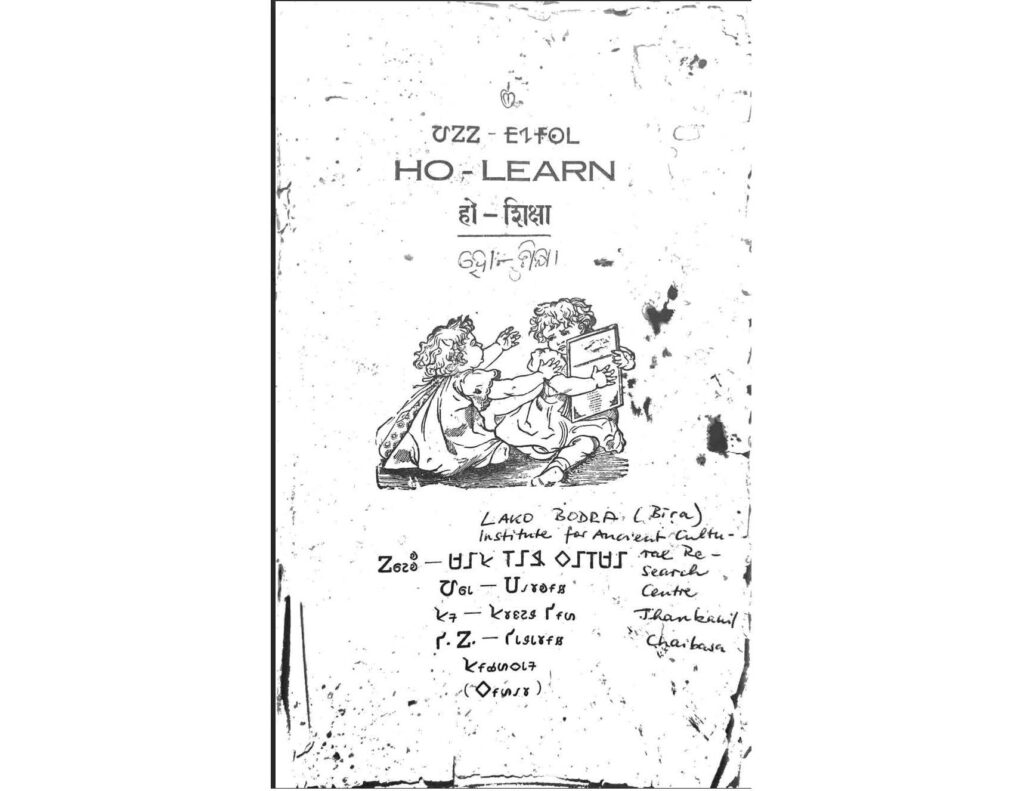
Warang Citi Ho script
Lako Bodra was a pioneering Ho intellectual whose work played a crucial role in the development and standardisation of the Ho language. He is best known for creating the Warang Citi script and for his extensive writings aimed at promoting literacy, cultural pride, and linguistic self-expression among Ho communities.
Bodra’s publications continue to influence language education and cultural movements today.
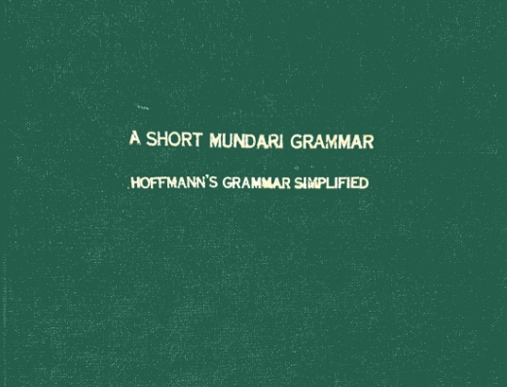
Hoffmann's Short Mundari grammar - simplified
Hoffmann’s Short Mundari Grammar is a concise and practical introduction to the structure of the Mundari language, an important Munda (Austroasiatic) language of eastern India. The present simplified version is a scanned copy originally obtained from someone working in the field—possibly the late Jesuit and scholar Peter Tete.
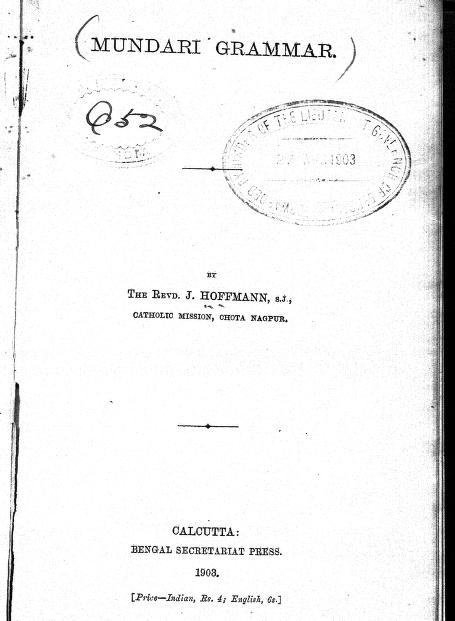
Mundari Grammar
Hoffmann, J. (1903). Mundari Grammar. Calcutta: Bengal Secretariat Press.
Mundari Grammar, written by John-Baptist Hoffmann and first published in 1903, is one of the earliest comprehensive studies of the Mundari language. The work represents a pioneering effort to systematically document the grammar of an Adivasi language at a time when very few indigenous languages of India had been formally analysed. Hoffmann’s deep engagement with the Mundari-speaking community enabled him to produce a detailed and structured account of the language.
The grammar outlines the sound system, word formation, and sentence structure of Mundari with clarity and precision. It explains noun and verb inflections, pronoun usage, particles, and syntactic patterns, supported by examples drawn from actual speech. Hoffmann’s analytical approach combined descriptive observation with practical application, making the book useful not only for scholars but also for learners and missionaries working in the region.